
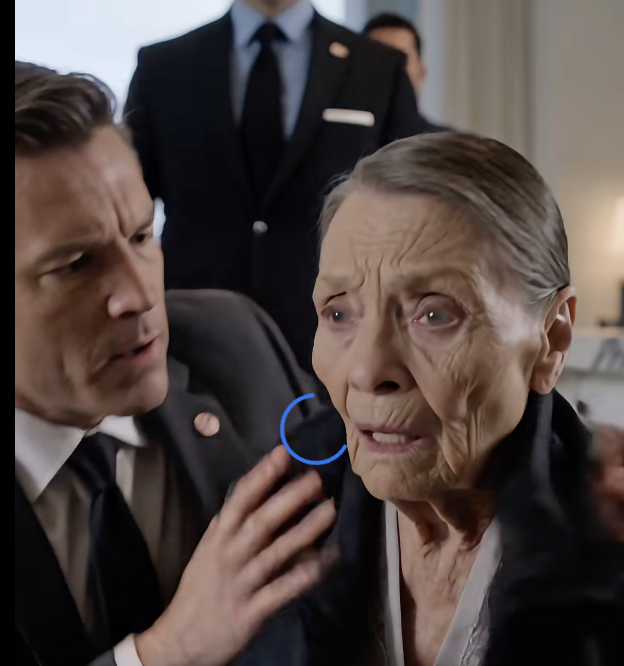
The words hung in the air like something too large for the room to contain. Markus stood rigid, staring at Sebastian as if the situation might still reverse itself if he thought hard enough. Claudia, however, was already calculating—her eyes shifting between Sebastian’s suit, the men behind him, and the contract she had just lost without understanding how final it was.
“You can’t just take her,” Markus said again, but his voice had lost its edge. It sounded more like habit than authority.
Sebastian didn’t even look at him. His attention stayed on Elisabeth, as if the rest of the room had already been dismissed.
“I’m not taking her,” Sebastian said quietly. “I’m returning what should never have been taken from her in the first place.”
Elisabeth’s fingers trembled as she clutched the edge of her ruined dress. “I don’t understand,” she whispered. “I have no place to go.”
That sentence landed differently than everything before it. It wasn’t dramatic or emotional. It was simply true. And because it was true, it exposed something no luxury apartment could hide: she had been erased slowly, one small humiliation at a time, until even her own home no longer felt like hers.
Sebastian turned slightly toward one of the suited men.
“Bring the car,” he said.
The man nodded and stepped out without a sound.
Claudia finally broke.
“This is absurd,” she said sharply, forcing a laugh that didn’t fully form. “She is my husband’s mother. Family matters are not decided by strangers walking in with bodyguards.”
Sebastian’s eyes shifted to her at last.
“Then behave like family,” he replied.
The simplicity of it silenced her more effectively than anger ever could.
Markus rubbed his forehead, pacing a step away from the counter. “This is about the contract, isn’t it?” he said, desperation creeping in. “We can renegotiate. Whatever she told you, whatever impression—”
Sebastian interrupted him without raising his voice.
“She told me nothing,” he said. “That’s the problem.”
Markus stopped.
Sebastian stepped closer to Elisabeth and gently adjusted the silk handkerchief he had used earlier, folding it and placing it into his pocket as if it were something worth keeping.
“When I was sixteen,” he continued, now speaking more to the room than to any single person, “she didn’t ask what I could give her. She didn’t assess my value. She didn’t decide whether I was useful.”
He looked briefly at Markus.
“She simply stopped.”
Elisabeth’s eyes glistened, but she still seemed distant, as if her mind was trying to travel backward through decades of silence.
“I remember a train station,” she said softly. “Snow… I think.”
Sebastian nodded once. “Munich Hauptbahnhof. December.”
A flicker passed through her expression—recognition, fragile but real.
“You were shaking,” she murmured. “I gave you my coat.”
“And you said,” Sebastian added gently, “that cold weather doesn’t decide who deserves to survive it.”
Claudia shifted uncomfortably, suddenly aware that the story she was witnessing didn’t belong to her world of branding, furniture, and appearances. It belonged to something older and more serious.
Markus exhaled, frustrated. “Even if that’s true, it doesn’t change anything now. She lives here. We take care of her.”
Elisabeth let out a short, humorless breath.
“Take care of me?” she repeated quietly, almost to herself.
It was the first time she had sounded awake.
Sebastian turned slightly toward her. “Do you feel taken care of here?”
The question was not accusatory. That made it worse.
Elisabeth didn’t answer immediately. Her gaze drifted across the penthouse—the untouched luxury, the cold surfaces, the invisible lines she was never meant to cross. Then she looked down at her hands, still faintly stained.
“No,” she said at last.
The word was small, but it changed the room more than any explosion could have.
Markus stopped pacing.
Claudia opened her mouth, then closed it again.
Sebastian nodded once, as if that answer confirmed something he already knew.
“Then you are leaving,” he said simply.
This time, no one argued.
Not because they agreed—but because something in the structure of the situation had collapsed. Arguments require shared authority. And suddenly, Markus and Claudia realized they no longer had any.
Within minutes, the silence of decision replaced the chaos of confrontation.
Outside, the car arrived.
Sebastian guided Elisabeth gently toward the door, staying close enough that she never had to balance alone. When they reached the threshold, she paused, looking back once at the apartment.
Not at the furniture.
Not at the son.
At the space where her life had been reduced to something she no longer recognized.
“Where will I go?” she asked again, softer this time.
Sebastian answered without hesitation.
“Somewhere you are not forgotten,” he said.
And for the first time that day, Elisabeth did not resist being led forward.
