
Harrington Hall had been built for nights like this.
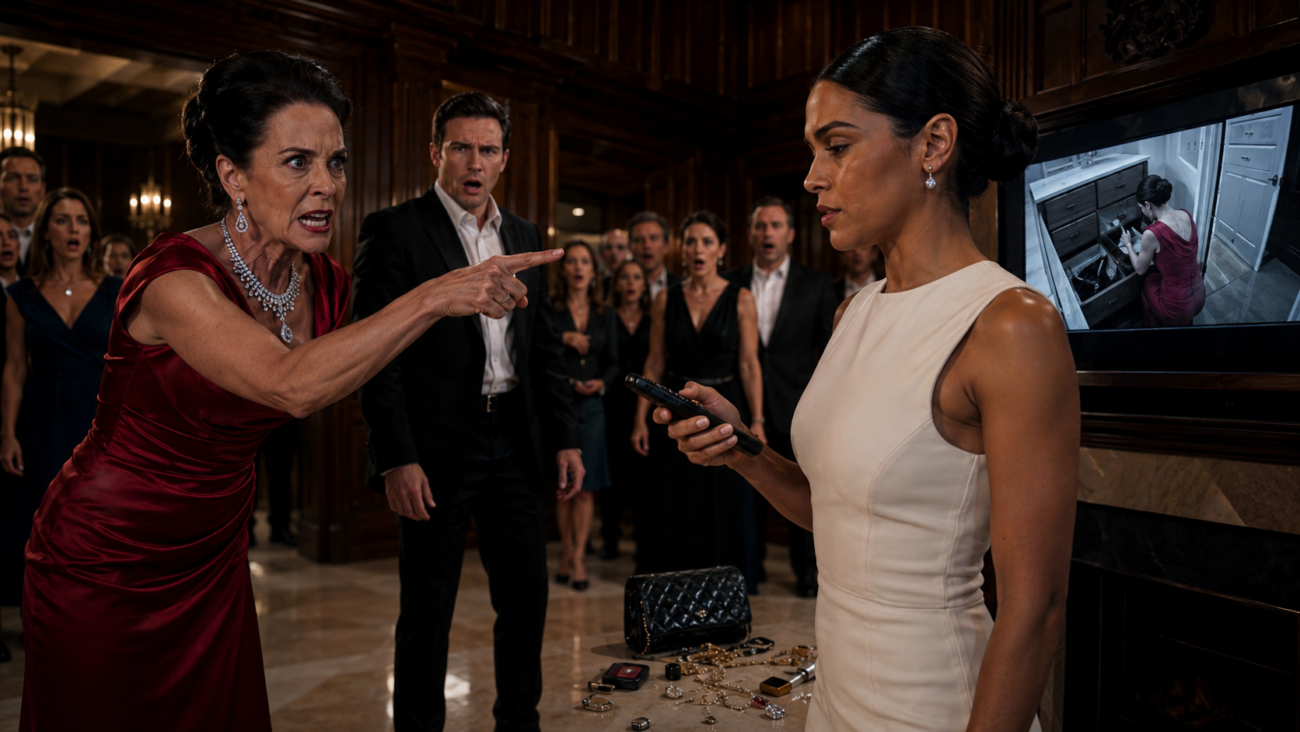
The grand foyer rose three stories high, paneled in dark polished wood and lit by amber chandeliers that made every diamond in the room sparkle. Men in black suits gathered beneath carved balconies. Women in evening gowns whispered behind crystal glasses. At the center of it all stood Ava Whitmore, motionless in a sleeveless white dress that made her look calm, almost untouchable.
But calm was the last thing she felt.
Across from her stood Eleanor Harrington, wrapped in a deep red satin gown, her silver necklace blazing under the lights like a weapon. Eleanor was not merely the hostess of the night. She was the widow of one of the richest men in the state, the mother of Mason Harrington, and the one woman in that house who had made it clear Ava would never be welcome.
Mason stood between them at first, confused and tense, one hand half-raised as if he wanted to stop something but did not yet know what. Behind him, relatives and guests gathered in a tight semicircle, drawn by the tone of Eleanor’s voice.
“Ava,” Eleanor said, smiling too brightly. “Would you like to explain why my private handbag was found open?”
The crowd shifted.
Ava looked down.
A black quilted handbag lay near Eleanor’s feet. It had been dropped hard enough that its gold clasp had sprung open. Lipstick, a compact mirror, a loose earring, a pill case, and several small items had scattered across the marble floor. The scene looked messy, staged, humiliating.
Ava knew exactly what it was meant to look like.
She also knew Eleanor had been waiting for an audience.
“I didn’t touch your bag,” Ava said quietly.
Eleanor’s smile sharpened.
“No?” she asked. “Then why were you seen near the east drawing room ten minutes before my bracelet disappeared?”
The words landed like a slap. A few people gasped. Someone behind Ava whispered, “Bracelet?”
Mason turned to his mother. “What bracelet?”
Eleanor lifted her chin, letting the room grow quiet before she answered.
“The Harrington sapphire bracelet. Your grandmother’s bracelet.”
The name alone changed the air. Everyone in the family knew that bracelet. It was not just jewelry. It was a symbol of the Harrington name, passed from one generation to the next, guarded like a crown.
Ava felt the trap close.
She had not seen the bracelet that night. She had not gone near Eleanor’s private room. But she had lived in Harrington Hall long enough to recognize the expression on Eleanor’s face. It was the same expression she wore when she smiled at staff before firing them, when she complimented a guest before destroying them, when she said “family” while meaning “control.”
Eleanor pointed one jeweled finger directly at Ava.
“Open your clutch.”
Ava’s heart thudded once.
Then again.
The guests leaned forward.
Mason looked at her with confusion, not accusation yet, but confusion was already dangerous. In a family like the Harringtons, doubt moved faster than truth.
Ava slowly looked at the black clutch in her own hand.
She had carried it all evening.
She had not opened it since arriving.
And suddenly she understood.
The bracelet was inside.
Ava could feel every stare like a hand pressing against her back. She noticed the smallest details because fear made the room too clear: the reflection of Eleanor’s red gown on the marble, Mason’s clenched jaw, the way one of his cousins lifted a phone before pretending to lower it. This was not just a family argument. It was becoming a performance, and Eleanor understood performances better than anyone.
Two weeks earlier, Mrs. Alvarez had warned Ava in the pantry, speaking so quietly that the running faucet covered her words. “Be careful at the gala,” she had said. “Mrs. Harrington has been asking questions.” Ava had wanted to believe the warning meant another cold remark, another seating insult, another attempt to make her feel like borrowed furniture. She had not wanted to believe Eleanor would go this far.
Now, standing in the center of the foyer, Ava understood that every insult had only been rehearsal. Eleanor had never wanted Mason to simply dislike her. She wanted him to distrust her. A broken engagement could be healed. A ruined reputation could follow Ava for the rest of her life.
That was why Ava did not cry.
If she cried, Eleanor would call it guilt. If she shouted, Eleanor would call it instability. If she ran, every whisper in the house would become permanent. So Ava stood still in the white dress Eleanor probably hated most, because white made lies look uglier when thrown against it.
And beneath the fear, a colder thought began to rise.
Eleanor had chosen a public stage.
Ava would answer on the same one.
